
Meeting Information
- Home
Local Info - Registration & Scholarships
- Hotel
- Using Zoom
- Why Attend?
Note: All times are Central Daylight Time (CDT) unless specified otherwise.
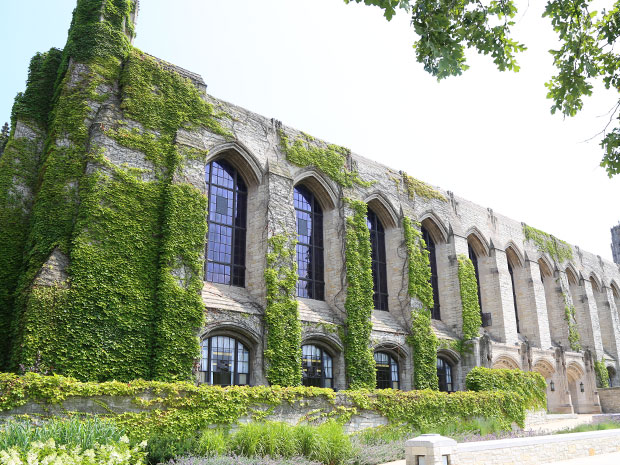
Featured image: Deering Library, Northwestern University
Thursday, October 15
2:00 p.m. – 5:00 p.m. CDT
Organ Crawl Evanston Edition: Come spend an afternoon visiting beautiful churches and organs in Evanston! We’ll meet in the Graduate Hotel lobby and visit three church organs. Bring your organ shoes, a short piece to play, and your fun-loving attitude. It will be a walking tour (total 3 miles from the hotel back to the hotel), though we can accommodate those who need help.
2:00 p.m. – 5:00 p.m. CDT
Northwestern University Library Tour: Comprised of two architecturally distinct buildings – Deering Library (Collegiate Gothic) and Main Library (Brutalist) – this tour includes not only the music collection, but distinctive spaces and collections such as the art collection, Herskovits Library of African Studies, Charles Deering McCormick Library of Special Collections and University Archives. We conclude with a visit to the world-class conservation lab. The tour will begin in the lobby of Deering Library.
2:30 p.m. – 4:30 p.m. CDT
Dawes House Tour: Step into the home of Former U.S. Vice President, ambassador to Great Britain, and Nobel Peace Prize winner, Charles Gates Dawes. This magnificent home, now a National Historic Landmark, sits on two acres overlooking Lake Michigan. Faithfully restored and conserved, this Châteauesque residence, designed by architect Henry Edwards-Ficken, includes a cherry paneled library, a vaulted dining room with a musicians’ gallery, six bedrooms, and twelve fireplaces. We will be treated to a one-hour guided tour. We will meet in the hotel lobby at 2:30 and proceed to the Dawes House on foot, a ½ mile walk. This tour involves a charge of $10.00 that participants will pay to the Dawes House on arrival. Limit ten people.
2:00 – 7:00 p.m. CDT
REGISTRATION
Graduate Hotel
5:00 p.m. CDT
Dinner Meet-Ups (meet in the hotel lobby)
Gather with a small group of MWMLA colleagues old and new, and together dine at one of Evanston’s many great restaurants. Meet your dinner guide in the hotel lobby; each group will be capped at 5 people + guide. Dinner is at your own expense.
Greg MacAyeal – NaKorn – Thai Fusion
Jill King – Habibi – Mediterranean Grill
Paul Cary – Prairie Moon – American Bistro
Andrea Tucci – Everest – Indian and Nepalese
7:00 p.m. – 9:00 p.m. CDT
RECEPTION FOR STUDENTS AND FIRST-TIME ATTENDEES
Graduate Hotel
Students and first-time attendees are invited to a dessert reception at the Graduate Hotel. Learn about MLA and the Chapter and meet officers and other members.
Friday, October 16
8:00 a.m. – 8:45 a.m. CDT
BREAKFAST & REGISTRATION
University Library
8:45 a.m. – 9:00 a.m. CDT
WELCOME & OPENING REMARKS
University Library
D.J. Hoek, Deputy University Librarian, Northwestern University
KICK-OFF SESSIONS
9:00 a.m. CDT
Hearing From the Front Row: A Talk with Howard Reich
Greg MacAyeal, Northwestern University; Howard Reich, Chicago Tribune, retired
Master storyteller and long-time Chicago Tribune jazz critic Howard Reich presents the story of jazz in Chicago. Describing the music, people and venues, Mr. Reich weaves a rich history based on his front row seat covering everyone in the city. In a conversation with Greg MacAyeal (Curator of Music Collections, Northwestern University) Mr. Reich will talk about Chicago based artists like Ahmad Jamal, Sun Ra, Von Freeman, Fred Anderson, Herbie Hancock, Ramsey Lewis, Patricia Barber and the AACM.
9:45 a.m. CDT
Likes, Reels, and Reference Desks: Social Media Outreach for Academic Libraries
Kyler Decker, Oberlin College and Conservatory
Over the past two years, I have served as the manager of the Oberlin Conservatory Library’s Instagram account. A role that transformed me from a social media skeptic into a passionate advocate for library outreach through digital platforms. Through researching contemporary marketing strategies and directly engaging with our target demographic of college students aged 18–25, I found that effective library social media requires a fundamentally different mindset than conventional institutional approaches. The goal of this presentation is to explore that shift: what it means to build an audience rather than just maintain a presence, and how to create content that genuinely resonates with students rather than simply broadcasting at them. I will also address the practical constraints that affect any social media program such as limited staff time, inconsistent institutional support, and the ever-present threat of creative burnout, as well as offer strategies for working within those realities. Attendees will leave with a clearer sense of what it means to build an audience rather than broadcast to one, as well as why that distinction is the foundation of effective library social media.
10:15 a.m. CDT
BREAK
CATALOGING & ACCESS BLOCK
10:30 a.m. CDT
Cool Stuff We’ve Described!
Co-sponsored by Cataloging and TAPS Interest Groups (Laikin Dantchenko, Indiana University, and Arpi Anderson, University of Kentucky, coordinators)
This fast-paced panel features four lightning talks on practical and innovative approaches to music cataloging, archival processing, sound archives, and artifact preservation.
Patty Falk (Bowling Green State University) analyzes shaped-disc recordings, including those in the form of Hawaiian shirts and Superman logos from the Music Library and the Bill Schurk Sound Archives, and addresses the challenges of description and preservation posed by non-standard formats. Jacey Kepich (Case Western Reserve University) demonstrates a use case for Google Gemini to transcribe and identify bibliographic information from a Hebrew-only songbook title page, enabling the identification of matching WorldCat records for copy cataloging. Colby Maddox (Old Town School of Folk Music) documents the provenance, preservation, and interpretive strategies surrounding Big Bill Broonzy’s 1946 Martin guitar and its use on European tours in the 1950s. MacConnell Wilson (Northwestern University) examines the processing of the Halim El-Dabh Papers as a first independent archival project, including the collection’s recent contribution of materials to an exhibition at Bard College.
These presentations collectively illustrate the current intersections among technology adoption, archival labor practices, material culture, and public engagement in music librarianship and archives.
11:20 a.m. CDT
Comprehensiveness of Discovery of Music Articles: A Study of Primo and JSTOR As Alternatives to Traditional Music Periodical Index Databases At One Institution
Michael Duffy, Geri Rinna, Western Michigan University
Across the nine-state area of Midwest Chapter of the Music Library Association, there are more than one hundred institutions of higher education that offer degrees in music and support those offerings with library collections and services. The academic study of music often requires access to published research in music, yet a plurality of these institutions do not hold subscriptions to any of the three major music periodical index databases, RILM Abstracts of Music Literature, The Music Index Online, or Music Periodicals Database. These institutions are responsible for connecting their music users with periodical content, in spite of not subscribing to any of these three major databases. This presentation examines the comprehensiveness of coverage of the contents of journals based on a sample first suggested by Leslie Troutman in a 2000 presentation at the International Association of Music Libraries, Archives and Documentation Centres conference, and later published in her 2003 article, “Comprehensiveness of Indexing in Three Music Periodical Index Databases,” published in Music Reference Services Quarterly. This sample is extended to include years after Troutman’s work and examines coverage of these journals by Primo and JSTOR at one institution that does not currently subscribe to any of the three major music periodical index databases.
11:45 a.m. CDT
LUNCH & BUSINESS MEETING
LIGHTNING TALK SESSION
1:15 p.m. CDT
Music Encoding At DHSI 2026: Developing a Workflow For Preserving Digital Scores
Paul Bishop, Wayne State University
When MakeMusic discontinued Finale music notation software in 2024, several of the files with proprietary .mus extensions were at risk of no longer being accessible. For music schools and libraries that support music students and faculty, this presents a long-term preservation challenge. MEI and MusicXML are file formats that provide an interoperable solution for preserving digital music scores. This poster outlines the methodology used for developing a workflow that converts Finale files into an interoperable format, stores them in a repository, and displays the scores in a web browser.
While attending the Digital Humanities Summer Institute in 2026, I developed a workflow for converting Finale files to MEI files using a variety of tools including Finale music notation software, VS Studio, and mei-friend. Following the file conversion, our DHSI instructor provided a “fork”, or copy of his DHSI GitHub repository which I was able to modify for my project, store all of my MEI files, and display them using Verovio music notation engraving library for MEI.
he result is a repository of interoperable music files both in MusicXML and MEI format that are machine-readable and can be opened and edited in notation software programs such as Sibelius, MuseScore, and Dorico, along with integrated environments such as VS Studio Code and mei-friend. With the exception of using Finale Music notation software, the entire project uses open-source tools and provides a workflow for preserving digital scores in an interoperable and interactive format. Attendees will gain insight into one iteration of a workflow that librarians, students, and faculty can use to convert digital music files into a long-term preservation format and share their work using open-source web tools.
1:30 p.m. CDT
Jumping Into the Deep-End: A Student’s Experience Working With the Walter Kaufmann Collection
Emily Paulson, Indiana University
How do music librarian students gain experience with special collections? In this presentation I will discuss my experience as a student crafting a special collections summer internship working with the Cook Music Library’s Walter Kaufmann Collection. With the help of faculty and staff, I developed and led a project to reorganize and rehouse the collection’s manuscript scores and parts due to increased interest in the collection and much needed updates to better preserve the materials. Through this internship and the rehousing project, I had the opportunity to learn many of the basics of special collection work including preservation, workflow documentation, crafting funding requests, and working with ArchivesSpace.
This presentation provides a unique perspective for students or early-career librarians who are curious about the glamorous (and not-so glamorous) behind-the-scenes work of special collections and provides an interesting example of how a student can get involved in special collections and “learn how to swim.
1:45 p.m. CDT
Enhancing Access to Resources Using Third Iron’s LibKey Nomad
Victoria Peters, Alicia Ikerd, DePauw University
This presentation describes how a liberal arts college’s academic library used Third Iron’s LibKey Nomad++ tool in order to connect their campus constituents to library subscribed resources from anywhere across the web. This presentation highlights some challenges specific to implementing domain messaging to appear across DePauw University’s resources, how we determined what resources to highlight, and how we have imported Third Iron’s usage data into SpringShare’s LibInsight in order to have a dashboard view of product impressions and clicks. The presentation also identifies ways that the usage statistics were incorporated into a dataset, and it describes methods applied as well as preliminary results.
MUSIC & SOCIETY BLOCK
2:00 p.m. CDT
Sonic Resistance On Vinyl: Reparative Cataloging of Ukranian Diaspora LPs
Laikin Dantchenko, Indiana University
During the Cold War, Ukrainian diaspora communities in North America produced independent LPs that represent cultural resistance to Soviet Russification. While the state monopoly record label, Melodiia, imposed Russian orthography, Russified names, and censored or reframed Ukrainian repertoires, émigré labels such as Arka, Rusalka, Request, Bruno Hi-Fi, CAL, and RCA Victor Custom restored Ukrainian Cyrillic, used phonetic transliterations based on Ukrainian pronunciation, supplied bilingual paratexts, and preserved folk songs, kolomyikas, bandura epics, and operas by Mykola Lysenko and Kyrylo Stetsenko. These recordings asserted linguistic sovereignty through cover imagery of vyshyvankas, bandura players, and rural life, circulating via dense grassroots networks of churches, gift shops, and community organizations.
Approximately fifty such LPs at Indiana University’s William and Gayle Cook Music Library, donated by Bloomington’s Ukrainian diaspora and collectors connected to postwar émigré networks, provide examples as portable archives of memory and resistance. Integrating diaspora scholarship, mobility studies, and Pierre Bourdieu’s framework of symbolic power, it shows how linguistic and paratextual design directly contested Soviet cultural erasure.
Central to the discussion is the Cook Music Library’s reparative cataloging project, which treats description as epistemic repair. Interventions include restoring access points in Ukrainian Cyrillic, correcting Russified name authority records, and enriching genre and thematic metadata. Case studies demonstrate practical strategies for improving the discoverability of vernacular while honoring community provenance and knowledge.
By framing cataloging as a decolonizing practice, the presentation offers actionable models for music librarians working with diaspora and contested sound recordings, illustrating how ethical metadata decisions can redress historical silences and support cultural resilience amid ongoing geopolitical challenges.
2:25 p.m. CDT
Grievability and Music in the Dwight D. Eisenhower Funeral Records
Chandler Hall, Lawrence University
On March 28, 1969, Former President Dwight D. Eisenhower passed away at Walter Reed Army Medical Center. His state funeral played out over the next five days, beginning in Washington, DC and concluding at the Eisenhower Presidential Library in Abilene, Kansas. This presentation foregrounds the archives as a site of negotiation surrounding the funeral events held at Washington National Cathedral on March 29, 30, and 31. Despite the centrality of music in articulating Eisenhower’s grievability at his funeral, the archives containing his funeral records do not privilege music as a category of organization. I argue that rather than undermining the importance of music to the funeral and its rhetorical function, the organization and structure of the archival collections reveal music’s embeddedness. Using documents held at the Cathedral, the Eisenhower Presidential Library, and the National Archives, I demonstrate how the structures of these archives situate funeral music within broader discourses of Eisenhower’s grievability. The archival schemata of these collections suggest that for one to contend with the funeral, they must face its music; and to face its music, one must contend with other aspects of its organization such as space, movement, personnel, and schedule. Building on the work of Judith Butler and Leeat Granek, I show that the funeral’s stakeholders had to negotiate both Eisenhower’s legacy and the role of music in enacting it. This presentation thus grapples with how music is an embedded practice implicated in the politics of grief and memory and demonstrates that archival schemata are themselves primary sources of historical musicological inquiry.
2:50 p.m. CDT
Library Renovations: Scope Creep Isn’t Always Bad, But I Hope You Have a Good Gantt Chart!
Kirstin Johnson, University of Illinois at Urbana Champaign
Library space renovations, often desperately needed and long hoped for, can come with unexpected challenges and opportunities. While being a large institution like the University of Illinois can be advantageous, it can also present obstacles. More space is more expensive to update, larger library collections are more complex to manage, and more patrons expect and rely on uninterrupted library services. During the Summer of 2026 the Music and Performing Arts Library at the University of Illinois Urbana-Champaign underwent a modest renovation to replace the ceiling and lights on the first floor. Although not as grand as needed or desired, limiting the renovation to one floor opened up other opportunities in the form of new carpet, paint, and improving staff workspace layout.
To complete the construction piece during the summer break, all 122,000 collection items on the first floor had to be relocated to the Main Library Stacks during Spring semester. Moving the book collection offsite introduced the possibility of finally joining the collection in one classification sequence (since they had been split between DDC and LCC since moving to the “new” Music Library in 1974). In addition, 90% of the shelving had to be temporarily removed from the space. This created the opportunity to get “new” shelving and relocate some of the old shelving to where it was more needed.
This series of interrelated projects required the efforts of seven Library departments in addition to MPAL and the campus’s Facilities and Services to accomplish. This presentation will offer an overview of the planning and scoping process for the renovation and related collections projects and describe the short- and long-term impacts and outcomes for the space, staff, services, collections, and patrons. There will be plenty of photos to entertain and, potentially, dismay.
3:15 p.m. CDT
BREAK
SPECIAL COLLECTIONS & ARCHIVES BLOCK
3:30 p.m. CDT
America 250 in the CCM Library: Performances and Displays of American Music in the Library
Rebecca Schreiber, University of Cincinnati College-Conservatory of Music Library
To complete the construction piece during the summer break, all 122,000 collection items on the first floor had to be relocated to the Main Library Stacks during Spring semester. Moving the book collection offsite introduced the possibility of finally joining the collection in one classification sequence (since they had been split between DDC and LCC since moving to the “new” Music Library in 1974). In addition, 90% of the shelving had to be temporarily removed from the space. This created the opportunity to get “new” shelving and relocate some of the old shelving to where it was more needed.
This series of interrelated projects required the efforts of seven Library departments in addition to MPAL and the campus’s Facilities and Services to accomplish. This presentation will offer an overview of the planning and scoping process for the renovation and related collections projects and describe the short- and long-term impacts and outcomes for the space, staff, services, collections, and patrons. There will be plenty of photos to entertain and, potentially, dismay.presentation explores the “America 250 in the CCM Library” concert as a valuable outreach opportunity to bring faculty, students, and community into the library and share an enjoyable and enlightening musical experience. As a stand-alone concert in the CCM Library Reading Room, the America 250 event provided the staff with ideas to improve strategies and increase engagement with future concerts and outreach activities. This presentation contributes to the ongoing MLA discussion around musical performances in libraries, as presented at the March 2026 conference and addressed through the Library Concert Interest Group, by highlighting a music library concert with the timely and significant theme of America 250.
3:55 p.m. CDT
Playing With Pleyel: Enriching and Remediating Existing Online Collections
Rebekah Erdman, University of Iowa
With over 200 items, the Ignaz Pleyel Collection held by the Rita Benton Music Library at the University of Iowa represents one of the largest assemblages in the United States of the early printed and manuscript scores of French composer and music publisher Ignaz Pleyel (1759–1831). The collection exists thanks to the efforts of the former head of the library, Dr. Rita Benton, who devised a catalogue for Pleyel’s works that accounted for the multitude of published editions and arrangements. With support from Dr. Benton’s family, the multi-year Ignaz Pleyel Project seeks to update and enrich the online presence of the collection to facilitate accessibility and utility for researchers, performers, and the general public. The first part of the project focuses on updating the library’s records in RISM to ensure that all items are accurately represented, as many records have not been revised since they were initially reported to RISM. Part two involves increasing the functionality of the digitized version of the collection curated by the University of Iowa via both image remediation and metadata enhancement, and the final part of the project will make the updated online collection widely accessible by sharing the updated digital collection with RISM and IMSLP/Petrucci Music Library. Time and resources permitting, the project will follow the same steps for items in the collection from Pleyel’s publishing company and design public-facing elements to convey the significance of the collection and sustain the legacy of Dr. Benton’s work. This presentation will describe the project’s goals as well as its challenges and progress.
4:15 p.m. CDT
Beyond the Glass…
Emma Dederick, Dr. Loida Garza, Lucy Rissmeyer, Indiana University
As we celebrate the Indiana University Latin American Music Center’s 65th year of promoting the academic study, performance, and research of Latin American musics, we expand our focus to bring our exhibits outside. Centennial celebrations of musical luminaries and current
events, like Celia Cruz’s 100th Birthday and Bad Bunny’s half time show, provide a window to evaluate and transform services for reaching wider audiences.
Exhibit cases with their size restrictions and permanent placement, limits the outreach and experiential learning, and constraints the narrative. This collaborative panel demonstrates how to partner students with faculty to promote collections and services beyond traditional library settings through pop-up libraries, multimedia outreach, and cross-campus partnerships.
5:00 p.m. CDT
ADJOURNMENT (until Saturday)
Saturday, October 17
8:00-8:45 a.m. CDT
BREAKFAST
University Library
COLLECTION DEVELOPMENT BLOCK
8:45 a.m. CDT
All Together Now: Collaboration In Music Collection Development
Maria Souliotis, University of Kentucky
In this presentation, I will discuss the evolution of my collection development activities over the course of my career. My current role frames music collection development as a collaborative endeavor, prompting me to modify my approaches to acquisitions, collection maintenance, and weeding. Activities conducted over the past academic year have necessitated collaborations with collection strategists, music catalogers, and School of Music faculty at my institution and addressed multiple collection areas simultaneously. This presentation will debrief these collaborations and reveal local priorities in collection maintenance. Librarians and paraprofessionals interested in undertaking team projects in collection development will gain ideas to adapt for use at their home institutions.
9:10 a.m. CDT
Behind the Curtain: Open Access In Performing Arts Librarianship
Eden Davis, THE Ohio State University
Open access (OA) has transformed scholarly communication. However, its adoption and practical application are uneven across humanities disciplines, including performing arts. This study examines how performing arts librarians engage with OA resources, the barriers they encounter, and the extent to which emerging trends like institutional
OA policies and artificial intelligence shape their work with OA. Using qualitative research design, eleven semi-structured interviews were conducted with performing arts librarians and analyzed using grounded theory methods.
The results indicate that OA resources are primarily used in supportive and supplementary roles, such as facilitating access when other resources are not available, supporting instruction, and contributing to open educational resources (OERs). However, OA is rarely treated as a primary source of scholarly material. Significant barriers to OA adoption were found to be structural, with copyright emerging as a key constraint. Layered rights associated with music, theatre, and dance materials were core to this barrier. Additional challenges include limited availability of high-quality and current resources, perceptions of inferior quality in OA, time constraints for source evaluation, and disciplinary models that prioritize royalties from creative works. Institutional OA policies were found to exert an uneven and mostly indirect influence. These policies have expanded performing arts librarians’ workload, often without additional support from their institutions. Artificial intelligence introduces potential benefits and concerns; however, direct impacts on participants’ experiences with OA were not common despite heightened concern.
Overall, this study highlights the tension between ideological support for OA and practical limitations imposed by legal, economic, and disciplinary factors. Performing arts librarians occupy a critical mediating role as they navigate access, quality, and complex copyright while supporting evolving practices in scholarly communication. The findings emphasize the need for more sustainable OA models and targeted policy interventions that account for unique challenges posed by performing arts scholarship.
COLLECTION MANAGEMENT BLOCK
9:45 a.m. CDT
From File to Folio: Rethinking PDF Score Printing Through Outsourcing
Melissa Moll and Katie Buehner, University of Iowa; Josh DeVries, Just a Theory Press
Many music libraries face a familiar challenge: how to transform a born-digital PDF score into a high-quality, printed and bound score and parts. At the University of Iowa, we relied for several years on an in-house workflow shaped by available equipment and staffing. While this approach sometimes succeeded, it was difficult to maintain consistently and nearly impossible to scale.
In summer 2026, we launched a pilot collaboration with Josh DeVries (founder and executive director of Just a Theory Press in Iowa City, Iowa) to explore outsourcing our PDF score printing and binding. This
partnership has the potential to allow the music library to collect more born-digital scores, which are being requested by faculty and students more and more often.
In this session, we’ll walk through our pilot workflow, including how we determined which components to outsource, key considerations for similar initiatives, and insights gained from the project.
10:10 a.m. CDT
Baby Got Backlog: A Multifaceted Approach to Managing Legacy Collections
Corinne Forstot-Burke, University of Michigan
In recent decades, collection development strategies in academic libraries have shifted from a “just in case” practice to “just in time” collecting. Previously, libraries were seemingly engaged in an arms race of collection building as well as accumulating and accepting donations and gifts-in-kind, trusting in their ability to execute proper stewardship of these collections in the future. Instead, libraries have experienced continued shrinking of technical services units, ongoing consolidation of roles and responsibilities, and the undermining of their overall capacity to process undescribed legacy collections. Librarians with large backlogs of material face the ethical dilemma of balancing the needs of legacy collections with new acquisitions and services. In this presentation, I will discuss the multifaceted approach we have employed to address the needs of legacy collections, including participating in collaborative approaches to archival processing, securing grant funding, engaging in digitization projects, exploring the re-selection and deaccessioning of materials, and transferring collections to another repository.
10:45 a.m. CDT
BREAK
ARTIFICIAL INTELLIGENCE BLOCK
11:00 a.m. CDT
How Are Music History Professors Addressing AI In Their Research Assignments?
Misti Shaw, Indiana University
At IU, I work with several music history professors to deliver information literacy instruction for their students who complete research assignments. In this presentation, I will share my experiences with how these professors are approaching AI usage in their class. This includes modifications to research assignments and the collaborative creation of new activities and assignments.
11:25 a.m. CDT
AI Is For mAIntenance: Improving Collection Care with CoPilot
Jacey Kepich, Case Western Reserve University
Known primarily for its STEM programs, Case Western Reserve University (CWRU) is preparing graduates for an economy increasingly influenced by AI. Even so, usage data at Kelvin Smith Library (KSL) – which supports CWRU’s College of Arts & Sciences, School of Engineering, and School of Management – reveal that music books consistently enjoy the highest circulation among KSL’s print collections. Since 2020, however, staffing and setup changes have reduced the amount of regular shelf-reading for music materials. In 2024, the music librarian initiated an inventory project to locate missing items, survey collection health, and advocate for increased attention. In order to effectively communicate her findings, she used Microsoft CoPilot to analyze and organize her data. Using AI yielded opportunities to align her work with institutional goals, such as AI competency, as well as highlight needs of the music collection to other teams in the library.
This presentation will offer insights into managing inventory workflow and incorporating AI to boost collection maintenance. Although the work is ongoing, utilizing CoPilot has led to additional collaborations within and beyond the library, increasing awareness of library collections and the care needed to keep them accessible. While not perfect, AI’s data-parsing abilities make it a helpful partner for analyzing trends, identifying action steps, and advocating for support.
12:00 p.m. CDT
WRAP-UP AND ADJOURNMENT! (until next year)